MDF: The Most Misunderstood Material in Cabinetry
Let’s clear the air about one of the most misunderstood materials in cabinetry: MDF.
The cabinet industry uses a wide range of materials. As a consumer shopping for cabinetry, you may come across a variety of terms to describe materials. For example, plywood, furniture core, particle board, and hardwood MDF. Today, we are focusing on “MDF” (medium-density fiberboard).
The term “MDF”, which stands for “Medium Density Fiberboard”, and its partner HDF, “High Density Fiberboard”, refer to a material that is smooth and stable. This material is not to be confused with another material, particle board. The two are entirely different. We will discuss particle board in another article.
Today’s MDF is one of the most consistent, smooth, and design-friendly materials that is actually used in most high-quality cabinetry. This includes not only our entry-level but also luxury lines like Candlelight Cabinetry and Tedd Wood Fine Cabinetry.
So before you write MDF off, let’s talk about what it really is, and why it absolutely deserves a seat at the design table.
1. What MDF Actually Is (and What It’s Not)
MDF stands for medium-density fiberboard. It’s made from wood fibers bonded together under heat and pressure.
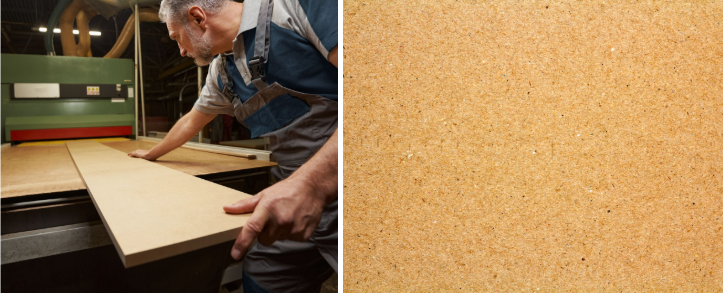
Here’s what it isn’t: particle board. Particle board is made by using large wood chips and glue (leading to weaker panels). MDF’s fibers are tiny, creating a dense, uniform structure that’s strong, stable, and smooth.
MDF Particle Board
2. Why Designers Love It
Ask any cabinet designer what they like about MDF, and you’ll probably hear the same things:
Perfect for painted finishes, MDF is smooth and takes paint well, resulting in a smooth, grain-free finish.
Stable: It’s resistant to warping and expansion. This keeps your cabinet doors straight and well-fitted according to their original design, even when it comes to kitchen cabinets and bathroom cabinets, which can often be in humid rooms.
Budget-conscious flexibility: You can get custom design looks at a more accessible price point, without sacrificing appearance.
These are reasons designers love MDF, yes, but they’re also reasons so many high-end lines use it for paint-grade doors and center panels. Not because it’s “cheap,” but because it’s the right material for the job.
3. MDF Is More Durable Than You Think
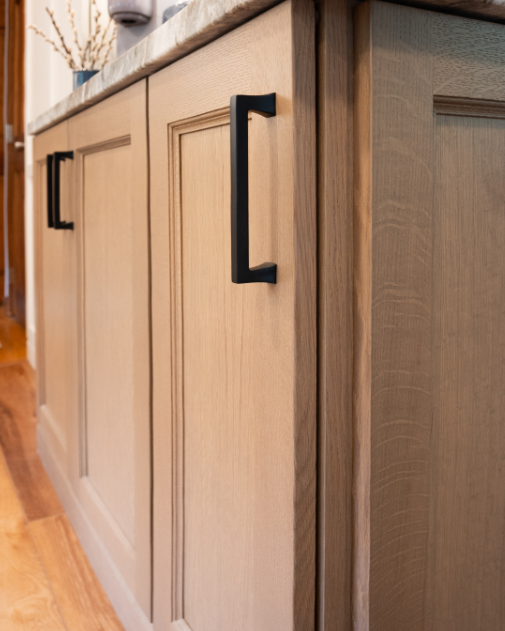
MDF can actually outperform solid wood in certain conditions.
Solid wood expands and contracts with temperature and humidity changes, which can cause cracks in painted finishes. MDF stays smooth and consistent.
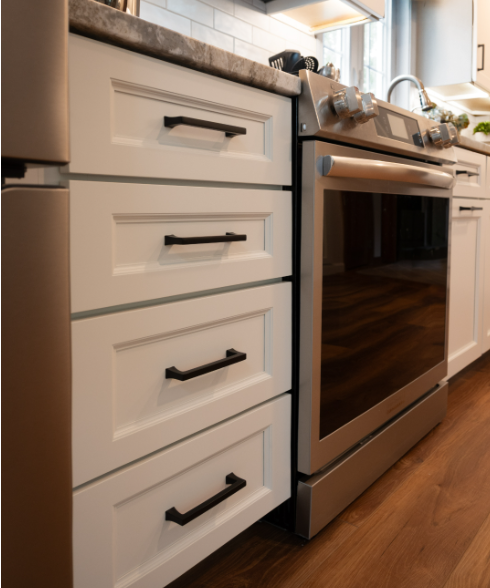
When properly sealed and finished (like it is when you work with professional cabinetry lines), it’s incredibly resistant to wear and tear.
4. Sustainability and Smart Use of Resources
MDF often uses wood fibers that would otherwise go to waste, which creates a use for what might’ve been discarded material. Many cabinet manufacturers use low-VOC, formaldehyde-free resins and source MDF from responsibly managed forests.
That makes it an environmentally friendly choice when sourced from trusted brands.
5. The Bottom Line
It’s time to give MDF the credit it deserves. It’s durable, stable, paint-friendly, and cost-effective, and when used in the right applications, it’s an excellent material for cabinetry.
At our showroom, we work with Wellborn Forest, Candlelight Cabinetry, Tedd Wood Fine Cabinetry, Jeffrey Alexander, and US Cabinet Depot. All of these use MDF strategically to deliver both performance and beauty.
Because in the end, the “best” material is the one that fits your design, your budget, and your lifestyle.
Want to see the difference quality materials make in person? Visit our showroom to explore cabinet door samples, compare finishes, and discover why MDF (and its solid wood friends) all have a place in today’s best kitchens.